October Multifamily Update: Bulls or Bears?
Some of my friends accuse me of being too bullish on the rental housing market. It’s fair game, and what fun is it if we can’t take some heat? But I can’t help but remember, not long ago, another set of friends scolding me for not being bullish enough.
When mortgage rates spiked and others beat the drum on how a weak homebuyer market would be a boon for rentals, I made the case for the OPPOSITE – theorizing that a weak homebuyer market could correlate with softer household formation and rent growth (which proved correct) and that the wave of new supply enduring prolonged lease-up would spur more renter turnover (which proved incorrect).
We win some, lose some. We just hope to get more right than we get wrong.
So here we are going into 2026. Moody’s says there’s a 48% chance of a recession (super helpful, guys, thanks!), and we have more doomsday voices out there fretting about a potential economic collapse.
I don’t feel especially bullish, but I’m also not convinced that doomsday is around the corner. Past doomsday calls haven’t aged well. (Remember 2020’s so-called “eviction tsunami” that never was?)
Is a recession possible? Absolutely. You can’t deny the cracks in the economy. But you also can’t deny the positive signals, as well … at least with the limited data we have (thanks to the government shutdown). And too many people just want to brush aside the signals they don’t like.
For now, the signals are mixed. Let’s review the evidence:
- The stock market continues to tick upward.
- The 10-year Treasury yields just dipped below 3%.
- Wage growth remains (as of last reporting) at a healthy clip.
- While hirings are super limited these days, so are firings. (Like consumers, businesses appear to be in “wait and see” mode.)
- While headlines scream about recent college grads being unable to find jobs, Federal Reserve data still shows around ~95% of recent grads are employed. (That’s still a solid number, though it IS lower than we’ve seen in years.)
- Overall unemployment (as of last reporting) has ticked up but is still comfortably below the long-term average.
- Apartment absorption remains above normal, at least according to CoStar, even if easing from record highs. But that’s coupled with soft leasing traffic and elevated vacancy, as that demand gets spread across a growing number of new properties.
- Softening rents are real, even in some lower-supplied markets. But that’s coupled with IMPROVING rent-to-income ratios among new lease signers, still-climbing retention rates, and still more of a “flight to quality” than a “flight to affordability.” Those aren’t tell-tale signs of weakening renter financial health — at least among renters in market-rate rentals.
There’s one economic variable worse than 2009. Do you know what it is? It’s consumer confidence. Which is odd because I remember 2009. It’s when I started in the rental housing research business. And unemployment reached 10% back then, more than 2x today’s rate. So, I can’t help but wonder if political fights and headline noise are souring our moods. (Other surveys show most Americans feel they’re personally doing fine but feel most other Americans are not.)
So, I can see two potential scenarios:
- UPSIDE: Remember summer of 2020 and again in middle of 2022? In those two periods, sentiment sank for different reasons – first COVID lockdowns and later due to inflation. In both instances, we saw signs of Americans pulling back … only to step back in once they realized the world wasn’t falling part. Best case scenario is today the same.
- DOWNSIDE: Weak sentiment and weak hirings give way to reduced consumer spending and layoffs. (Even worse: Re-accelerated inflation coupled with job reductions.)
So, we’ll see what happens. But I can sympathize with Moody’s playing it down the middle with its 48% probability number.
Now let’s talk about how this is impacting the apartment market.
What’ll be the impact to the apartment market?
If (big “if”) the economy finds its footing (even if just slow and steady growth), then 2026 becomes the year occupancy rates stabilize and concessions burn off – triggering the beginning of a rent rebound that could further accelerate in 2027 and 2028.
If the economy sputters, then that likely prolongs the slump. While rental housing tends to have a high floor in a downturn, it’s certainly not immune to the impact of a recession. In that scenario, occupancy stays weak longer, concessions stay elevated, and rents remain soft. (Of course, construction starts would also remain very limited, setting the stage for eventual rebound, but the recovery date gets pushed out.)
It’d be wise to plan for a downside scenario, even if it’s not your base-case scenario.
Let’s dive into the latest apartment data in more detail…
Is Demand Softening?
We’re starting to see some noise in the apartment demand numbers. Or more precisely: apartment absorption. Remember that data providers track demand in terms of absorption, which is the net change in the number of occupied units (aka household formation). Those numbers have been sky-high for a while, even as leasing activity (traffic, lease signings, vacancy) remains soft.
RealPage reported a moderate Q3 absorption number (+42k units), while CoStar reported a much stronger number (+129k units, which is ~50% above the long-term norm for Q3). Why the gap? I’ll spare you the wonky methodology stuff, but I suspect some of this traces to how different data providers calculate lease-up absorption. More tellingly, CoStar and RealPage are more aligned on T-12 absorption – with RealPage showing more in 1H’25, and now the CoStar number closing the gap.
Also: We should acknowledge that absorption tends to follow supply (you can only absorb what’s available, so more supply spurs more absorption). That means absorption will almost certainly drop as supply drops off, regardless of what happens in the economy.
If absorption drops off but vacancy improves as supply drops further, that’s no big deal. If absorption drops off and vacancy worsens, that’s a lot more concerning.
The Rent Slowdown is Real
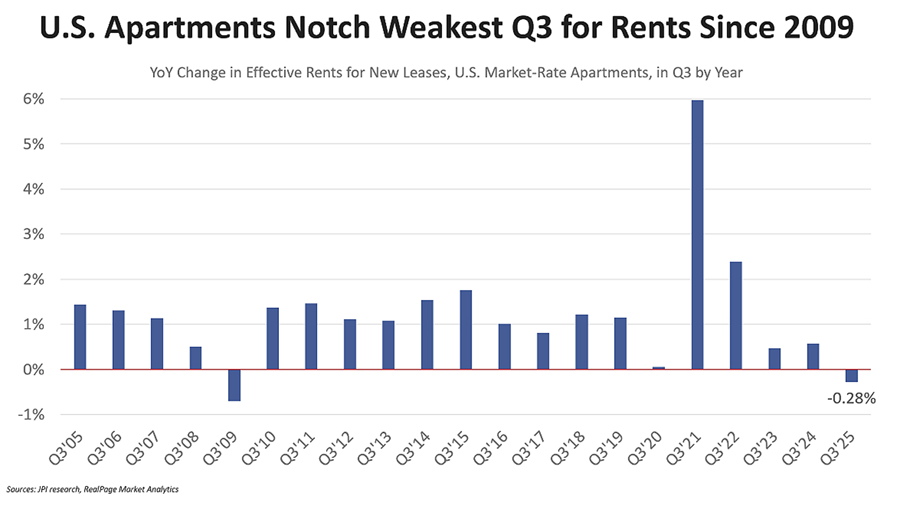
RealPage showed rents falling in Q3 for the first time in 15 years. It wasn’t much, but we typically see increases of 1%+ in a normal Q3. RealPage’s year-over-year rent change number also went negative for the first time since early 2021. CoStar shows rent growth still positive year-over-year, but barely – with the pace of growth further cooling in Q3. CoStar also reported that September’s month-over-month rent cut was the deepest in 15 years.
Most other data providers – Yardi and Apartment List – show similar trends.
The One (and Only?) Thing We Do Know For Sure
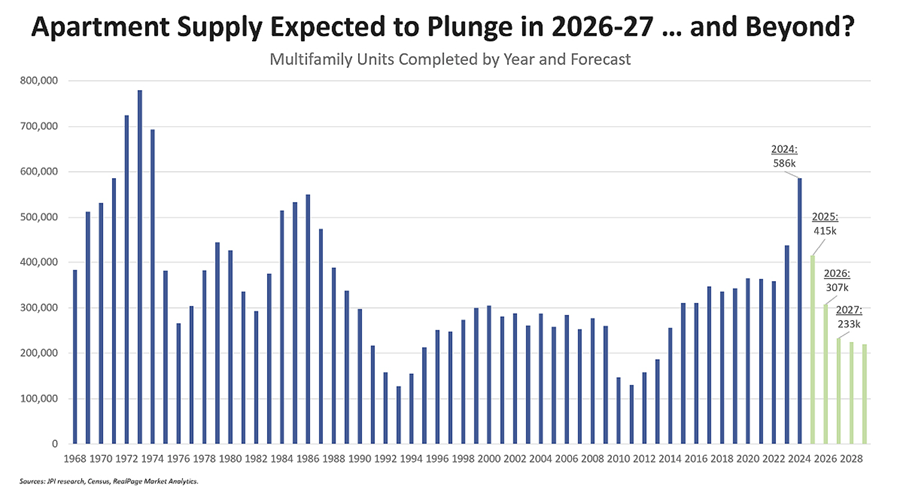
Supply is going down. Way down. Apartment starts appearing to the be settling in around levels last seen in 2013, according to both CoStar and RealPage. At this point, we know 2026 and 2027 will be low-supply years, and 2028 is looking like a strong candidate to be a low-supply year, too. BTR starts are way down, too.