
November Apartment Update: Stable Current Renters, Nervous Prospective Renters
Here’s my take – admittedly through some foggy lenses right now – on the current state of the U.S. apartment market here in November 2025:
- CURRENT renters are doing fine, at least for now.
- PROSPECTIVE renters are (mostly) sidelined.
I think those two simple statements sum it all up, and I’m not trying to be trite. It may not be true tomorrow or one month from now, but I really believe that’s true as of the publishing date of this newsletter. It was also the sentiment among most of the apartment REITs during their earnings calls in recent weeks.
As I wrote last month, there’s plenty of red meat data for both the bears and the bulls to chew on right now. What you choose to chew on likely reflects which side you’ve staked your tent on.
For most CURRENT renters, there’s no real sign yet of any real distress. No signs of increased rental delinquency, no signs of doubling up, no signs of a “flight to affordability” (in fact, it’s still more of the opposite) and no signs of increased turnover.
- On their recent earnings call, EQR’s Mark Parrell said his company sees no “signs of customer financial distress.”
- Camden’s Keith Oden (who’s been at it for 30+ years at CPT) added that apartment managers “know immediately when people start losing their jobs because they move out.. It’s almost automatic … and we’re not seeing that.”
So that part is good. And let’s not be among those allergic to good news. But we can point out the good news while also acknowledging the bad news: In-bound leasing traffic appears to be slowing in some parts of the country – notably in some previously strong markets now seeing negative economic headlines, like Boston and Washington, D.C.
Many PROSPECTIVE renters appear to be sidelined, frozen in temporary living arrangements as they wait out better times. There’s clearly a correlation between low leasing traffic and low consumer sentiment: When people feel nervous, they’re less likely to make a major decision – like relocating to sign a new lease. Of course, the soft job market for new college grads (a key source of apartment demand) likely isn’t helping, either. That’s all pent-up demand for better days.
The irony? It’s very much a renter’s market today.
- Rents are falling in half of the nation’s 150 largest MSAs, and still predominantly in the hottest-demand markets.
- Concession values are the richest today in 15 years.
- And renters have a lot of available options thanks to the biggest supply wave in a half century – opening up not only brand-new luxury buildings, but also pushing up vacancy in older, cheaper units as some of the better-off renters in those units move up.
But that’s typically how it works: When supply exceeds demand, renters can usually find better deals. When demand exceeds supply, pricing power usually intensify.
Rent Growth Evaporates Even as Occupancy Holds Stable
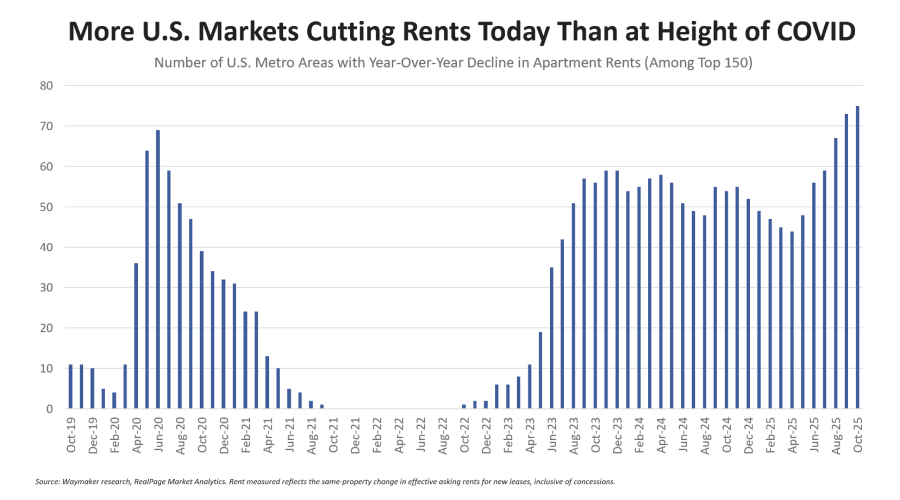
Most rent tracking focuses on new lease rents, and given more supply than demand in much of the country plus weak consumer sentiment, it’s no surprise that operators continue to give on pricing to protect occupancy.
For the most part, that strategy has worked. Yardi and RealPage both reported slight IMPROVEMENT of 10 bps year-over-year in stabilized occupancy rates (though CoStar did report a slight decline), and most REITs reported similar success.
But here’s the rub: To keep occupancy high, you’re competing on price – even for renters who can easily afford it. Renters “expect a deal,” as Camden’s Ric Campo said, so to get units filled in this environment you have to play ball.
CoStar reported an October rent cut of 0.31% nationally. While not drastic, it was still the deepest October rent cut in 15 years. CoStar also added: “Three of the five steepest monthly rent reductions over the past fifteen years have occurred within the last three months.” Those aforementioned month-over-month cuts ranged from 0.21% to 0.31%, taking year-over-year change to a still-positive-but-barely at +0.8%.
- Rents are falling (or rent growth levels are cooling) not only in high-supplied markets, but also in select coastal markets with softening demand – notably Washington DC, Boston, San Diego and Los Angeles.
- But rents continue to increase in markets with low supply plus steadier/improving demand, led by San Francisco, San Jose, New York and Chicago. All major data providers listed those four among the top rent growth markets, with others mentioned including Pittsburgh, Virginia Beach, Minneapolis, Milwaukee and Cincinnati.
- AND we’re also seeing green shoots of improved rent momentum (in some cases, rents still falling but to lesser degrees) in higher-supplied markets like Atlanta, Orlando, San Antonio, Austin and Denver — places where rents are still falling, but at a lesser degree than previously. Several REITs said similar in recent weeks, and listed Dallas among those with improvement.
- Yardi also noted occupancy improvement in some high-supplied markets, reporting: “Several high-supply markets—led by Atlanta (0.9% year-over-year), Charlotte (0.5%), Phoenix, Nashville and Orlando (all 0.3%)—posted occupancy gains due to strong annual absorption. Even Austin and Denver, which were flat year-over-year, managed to avoid declines.”
- Despite the bit of momentum, Austin and Denver rank among the weakest rent markets for most big data providers. Phoenix and Tucson are usually in that group, too.
Bottom line: It’s still a story of mixed signals. The end to the government shutdown could certainly help, especially in the D.C. area. But the next jobs and inflation reports – once they get released following a one-month hiatus thanks to the shutdown – will likely carry outsized influence, as well, particularly for employers.