
September Apartment Market Update: The Summer Lull
Monday brought the official end of summer, the autumnal equinox marking a new season – fall. Apartment owners and operators can only hope fall proves better than the summer. Because it was a rough summer for the multifamily market.
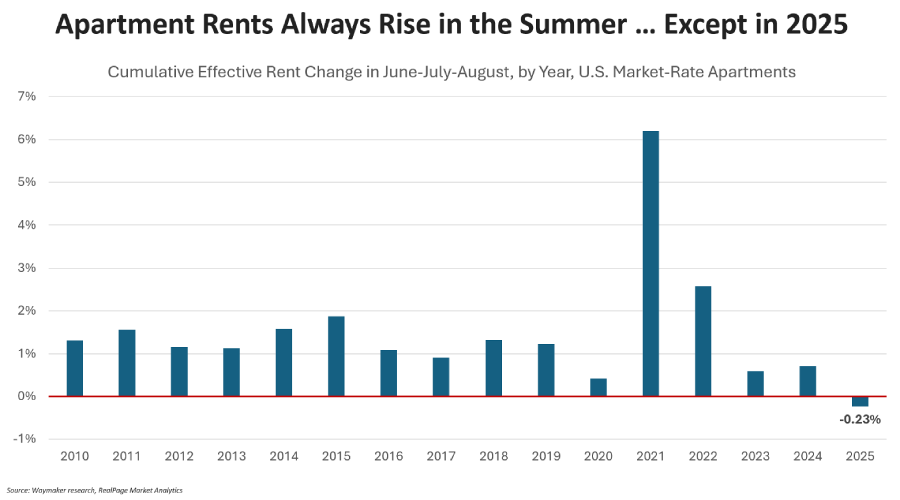
Effective rents over the combined core summer months (June-July-August) fell for the first time since the Great Financial Crisis. It wasn’t an especially deep cut (-0.23%), but it’s a stark departure from the normal seasonal pattern of +1% or so. Part of that rent softening came via concessions – even in stabilized properties, with average discounts soaring to the highest level (around 6 weeks “free”) since the early 2010s.
What’s going on? We’re a broken record at this point, but supply is obviously the main driver. Completions peaked in 2024, but much of that arrived late in the year – shoving a historic-sized wave of lease-ups into 2025. On top of those, the 2025 supply totals would look very large in comparison to any recent year other than 2024. It’s a lot.
Furthermore: Retention rates remain high and renewal rent growth remains solid, so the challenges are squarely on the new lease side.
Is It the Economy?
Of course, we must acknowledge more signs of jitteriness in the economy. Job growth slowed to just 22,000 jobs added in August, plus revised numbers showing actual job losses (-13,000) in June. Fed chair Jerome Powell called it an “interesting labor market” right now, noting that “kids coming out of college and younger people, minorities – are having a hard time finding jobs. The overall job finding rate is very, very low. However, the layoff rate is also very low. So you’ve got a low – a low firing, low hiring environment.”
Of course, the “kids coming out of college and younger people” demographic is an especially important one for apartments.
At the same time, every data provider has – at least so far – continued to show very strong net absorption numbers. Some of that is propped up by low turnover (including renters renting longer due to challenges buying homes), but that doesn’t explain all the net new demand.
But you can’t help but wonder if absorption would be even stronger if more recent college graduates quickly found jobs. That would certainly be a logical assumption.
The upside: As Powell noted, there’s also not a lot of layoffs. Unemployment is still low, even if up slightly. So maybe employers are just nervous, as are consumers. Maybe confidence returns, job growth returns, and we see some pent-up demand for apartments released among recent college graduates – boosting the post-supply rebound story for multifamily. Or so we can hope.
More Highlights
- Yardi says “this deceleration is driven by supply rather than demand, as elevated deliveries have created a highly competitive leasing environment amid record absorption.” But also adds that “operators are concerned that it will soften through the second half of the year” due to a softer job market.
- RealPage data shows year-over-year effective rents falling (-0.2%) for the first time since early 2021. By comparison, CoStar and Yardi still show slight rent growth.
- CoStar reported two straight months of “flat or negative national monthly rent change,” and noted all four regions of the country recorded month-over-month rent cuts in August.
- Yardi writes that “if the pattern holds, rents will change little in coming months.” So all eyes are on spring 2026.
- Radix called the multifamily market “steady” and “in line with recent reports,” with minimal rent growth coupled with stable leasing traffic and occupancy.
- CoStar reports that apartment construction is “plummeting nearly 50% from its peak” in the Sun Belt.
- San Francisco remains a notable exception to the rent slowdown rule, as it continues its rebound following nearly five years of softness. Both RealPage and CoStar ranked San Francisco as the #1 major market for rent growth in August. Yardi ranks Chicago as #1 and San Francisco at #8.